


Restoring Canada’s immigration policy to the ‘pre-Trudeau era’ won’t suffice. Decades before he appeared on the scene, immigration policy had stopped serving Canadians and newcomers alike.
FALLING FOR A MIRAGE
For as long as I have lived in Canada, immigration has been the third rail of Canadian politics. Very few souls were intrepid enough to go against the prevailing narrative that immigration was unquestionably good for both Canada and the immigrants. As a consequence of the excesses during PM Trudeau’s tenure, the dam has finally broken, as ever more people abandon the camp of “No level of immigration is too high”. Concomitantly, it has become an article of faith that all that is required to fix the mess we are in is to go back to the immigration policy of the ‘pre-Trudeau era’, plus some ancillary actions such as building more homes, scrapping the policy of ‘safer supply’ of hard drugs and so on.
This set of beliefs stems from one of the two articles of faith that predate Justin Trudeau’s tenure as prime minister, viz., that Canada’s immigration policy was the gold standard, one that other countries envied (the other article of faith was that Canada’s universal healthcare system was ‘the best in the world’ – which we will look at shortly).
Envy is an emotion and therefore cannot be analyzed objectively – but we can certainly examine, with the help of data, whether the pre-Trudeau immigration policy qualifies as a ‘gold standard’, i.e., whether it increased the well-being of all who live in Canada.
ROSE-TINTED REAR-VIEW MIRROR
I think it can be accepted without argument that a ‘gold standard’ model of immigration policy would increase the financial well-being of all Canadians, including newcomers. This is in fact the claimed effect of immigration in Canada. However, as I wrote in my article ‘Immigration Does NOT Increase Prosperity’, it stopped being the reality some time around 1970. What is more, once you strip out inflation, the Compounded Average Growth Rate (CAGR) in per capita GDP declined steadily – one would be justified in using the term ‘precipitously’ – between 1970 and 2021.
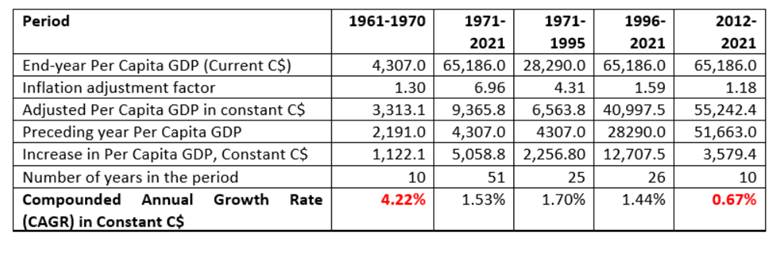
In other words, over a period of 51 years, real per capita GDP went from growing at a CAGR of a robust 4.22% to an anemic 0.67%, which represents a decline of 84%. This is NOT to suggest that the decline was caused by immigration, or even that immigration was one of the factors behind the decline. My point here is that having immigration is not a guarantee for increased prosperity; there are other, more powerful forces that outweigh any benefits that may accrue from immigration. Therefore, instead of pining to restore our immigration policy to an illusory ‘gold standard’ – as if it is a panacea that would cure everything that ails us at the moment – that is supposed to have existed in the ‘pre-Trudeau era’, we need some difficult discussions on the causes of the inexorable economic decline that persisted for over half a century. Absent this discussion, any ‘solution’ that we settle upon (that is, IF we do that; more on this in a bit) is bound to result in severe disappointment.
CHRONIC ILLNESS
Let us now turn to the other pre-Trudeau article of faith, viz., that Canada’s universal healthcare system is ‘the best in the world’. In fairness, this belief is challenged a lot more frequently, and a lot more energetically, than the one about immigration. Nevertheless, the belief does enjoy dominance in the public arena, leaving any dissenters open to accusations and name-calling, typically via raising the bogeyman of ‘US-style healthcare’, which is presented as the absolutely worst evil that can exist in this universe.
In the context of the present discussion, the deciding question is, does immigration improve delivery of healthcare? In theory, it can – as I have witnessed firsthand in Kenya and the UAE. However, Canada has failed to capitalize on immigration for this objective. I have written extensively about the relentless deterioration of the healthcare system (over a dozen articles in all), but in a nutshell, the following data-points from my articles ‘Canada’s Healthcare Crisis’ and ‘Canadian Healthcare Is NOT Underfunded’ are particularly relevant in this discussion:
- Between 1970 & 2019, the number of hospital beds per 1,000 people in Canada went down from 7.0 to 2.5. This represents a drop of 64%.
- The above numbers mean that between 1970 & 2019, the actual number of hospital beds in Canada DROPPED by about 55,000.
- In 2019, the OECD average for hospital beds per 1,000 people was 5.0, exactly twice that of Canada.
- Between 1993 and 2019, the wait time for treatment by a specialist increased from 9.3 weeks to 20.8 weeks. (Update: according the latest report by the Fraser Institute, this number stands at 30 weeks for 2024).
- Between 1975 and 2019, healthcare spending in Canada increased from 7.0% of GDP to 11.6% of GDP. (Update: According to the Canadian Institute for Health Information (CIHI), the number for 2024 is 12.4% of GDP.)
The sum total of the above data is that healthcare spending in Canada yields a negative marginal return on delivery; while the spending increased by over 77%, availability kept declining year after year. Given that we are dealing with data here, it should be possible to construct an econometric model to calculate the relative change in satisfaction (and since it is negative, we can call it ‘misery’). I didn’t find one existing, so I constructed my own, which you can read about in my article ‘Measuring Misery’. For those short on time, here is the synopsis: from a baseline value of 100 in the year 1993, the index rose to 367.7 in the year 2019. In other words, each dollar of healthcare spending was giving us just a little over 27 cents worth of healthcare delivery in 2019, as compared to 1993 (Note: the numbers are adjusted for inflation). If we return to this ‘pre-Trudeau era’ model (as a lot of Canadians are pining for), by the year 2045, each dollar of healthcare spending will deliver a meagre 7.34 cents worth of healthcare. I don’t think a decline of over 94% in the efficiency of any system can qualify as a ‘gold standard’ by any yardstick; in fact, it would be impossible to avoid the conclusion that the system is a disaster of epic proportions.
GRADUALLY AT FIRST, THEN SUDDENLY
With that data on the inexorable decline on two major metrics, stretching for half a century, I am prepared to say that Justin Trudeau’s folly was to turbocharge the process of deterioration that had already been afoot for over 4 decades before he became prime minister. Had he stayed the course and kept the policy on the ‘managed decline’ setting, he wouldn’t be seen by so many Canadians as the author of Canada’s multi-front misfortune that we find ourselves facing today.
It is popular in the anti-mass immigration circles to focus – perhaps ‘fixate’ is a better term – on the huge influx of temporary residents from 2022 onwards. But even prior to that, some fundamental changes had been made to immigration policy – such as removing the requirement for a medical examination before a visa could be issued and allowing sponsored parents / grandparents to live in Canada for up to 5 years at a stretch as ‘visitors’; these changes essentially went unopposed, from both the media and the official opposition party of the time, viz., CPC and NDP respectively.
The end result was akin to a tree that has been hollowed out by parasitic insects – when hit by gale force winds, it topples over. Understanding why it toppled over requires knowledge of what transpired before the tree was hit by gale force winds. In the context of this article, the steady deterioration that was allowed to take place in Canada was the equivalent of the parasitic insects, and Justin Trudeau’s turbocharging of the process was the gale force wind.
In a video podcast on my YouTube channel a couple of months ago (Why small-c conservatives will never be a potent political force in Canada), I had offered my view that one of the factors behind this is ‘disinterest in politics’. This may sound shocking to some, but the fact is that while the Leftists are advancing their policy goals relentlessly, those on the Right are blissfully unaware of what is happening; their vocal opposition to these policies comes only as a belated reaction to what the Leftists have made fait accompli. For example, try finding any critique of Motion M-44 (that threw the floodgates of mass immigration of unskilled, unvetted foreigners wide open) in the time it was presented in the House of Commons and was being debated / voted on – or even in its wake. At the political level, the agreement was unanimous; the Motion passed by a vote of 324-0. As we have seen over the past two years, the task to undo the damage caused by this Motion is Herculean – perhaps even Sisyphean.
LEAKY ROOF
Unlike GDP growth and healthcare, I have not taken a data-based deep dive into the housing situation. I have written some articles about it, but for a data-based approach to housing, my top go-to sources on X are Professor Mike Moffat, Ben Rabidoux, Hanif Bayat and Stephen Punwasi. It would be great if someone could compile their work that gives us a consolidated view of how we ended up where we are now. There can be no argument that in order to fix a mess, it is imperative to know how it was allowed to occur in the first place.
Sadly, that is not how Canadian politics operates. As a result, a couple of years ago we saw the then-Prime Minister Trudeau make the puff-chested announcement that he would get 3.9 million homes built over the following 7 years. Various Premiers and Mayors followed suit, announcing their own boastful measures and numbers. The only voices of doubt came from private individuals – the MSM was predictably performing its role of stenographers for the government. It was the private individuals who asked whether we had the number of qualified workers needed to scale up construction to deliver the announced numbers.
However, from a broader view, different kinds of resources would need to be scaled up, viz., physical (the materials), manpower (if you will excuse the sexist term) and financial. I spoke about the last one in my audio podcast ‘Building 4 million homes? Not so fast’ in May 2024 (you can listen to it at this YouTube link). In a nutshell, theoretically speaking, the vast amount of additional capital required to double the scale of construction can only come from one or more of these four sources: (1) presently undeployed capital, (2) diverting capital from other uses, (3) foreign sources (popularly known as ‘foreign direct investment’ or FDI) and (4) newly generated investable surplus in the Canadian economy. In my view, none of these are viable options.
MANAGEMENT SCIENCE
Data coming out now shows irrefutably that the actual delivery on these lofty promises on housing is way shorter that what was promised. I, for one, am not surprised – the numbers were arrived at via a political lens (‘What number would make it look like we are doing something?’) rather than by a rigorous scientific calculation.
How would / should this calculation be carried out? First, you would have to arrive at a quantified standard that we want to achieve. Let’s take hospital beds per 1,000 as an example. The OECD average is 5.0, while in Canada we have only 2.5 of them. How much higher should the number for Canada be? Let’s assume that the OECD number is agreed upon as the goal. We would have to break up the required increase into several phases, going to the granular level of each municipality (it wouldn’t serve us well to have the beds distributed across the country in a lopsided manner). From this matrix of municipal-level numbers, we can work out the resources required and then figure out how we can procure / devote these resources over a period of time. THEN would have a defined goal.
What happened in the case of the housing announcements was that the goals were announced without the benefit of any exercise of this nature. The appearance of thoroughness was contrived via the modality of announcing ‘funding’ of large amounts of money. These announcements were not dissimilar to someone declaring that they would conduct certain scientific experiments after landing on the moon – without giving a single thought as to how they would get there in the first place. This ‘thought deficiency’ in our politics, media and academia is not limited to housing; it is all-pervasive.
THE CRUX
We have enormous challenges on many fronts. Of these, the most talked about are housing, cost of living, healthcare and employment (sorry, climate crusaders, your pet cause is not on the list of most Canadians, contrary to what the MSM and most politicians have led you to believe). Since we need to set goals for each of these at the granular level, there will be a plethora of them. The trillion-dollar question is, are Canadians pragmatic enough to arrive at these? Or even a few of these? From my observation over the years, the answer is, sadly, a resolute ‘No’.
Nearly 5 years ago, in an article titled ‘Structural Dysfunction’, I narrated why I think so. Here are some excerpts from that article:
- jingoism reinforced by lack of actual information on the subjects under discussion.
- the voluminous combined literature of historical accounts and current reporting failed to inform public opinion in Canada regarding policy on these issues.
- the arguments on both sides were frozen in time.
- instead of having a marketplace for competing ideas, what we have in Canada is an ongoing battle between ideologies.
- We are no longer a nation of people sharing a sense of destiny, but rather different groups that seek to subjugate each other.
- every bit of policy is hotly contested in terms of what the facts are.
Since I wrote that article in January 2021, these observations have been validated time and time again. In his book ‘Prey’, the late Michael Crichton has talked about the ‘evolutionary algorithm’, wherein sentient beings remember their experiences, the choices they made and the outcomes that ensued. I am of the firm view that Canadian society – at least in the present times – completely lacks the evolutionary algorithm. Whether or not we are able to restore the ‘pre-Trudeau era’ immigration policy is irrelevant. Our goal should be to restore the ‘pre-1970 era’ wellbeing of Canadians, updated for the current times, based on quantified targets at the granular level (for example, that by the end of 2027, the percentage of Canadians without a family doctor will be reduced from 14% to 10%, with the proviso that no health region will have this number at higher than 12%). But this isn’t even on anyone’s radar.
PEOPLE POWER
Humans have an innate desire for a sense of belonging. This is misused by an assortment or entities (politicians, activists, ideologues and special interest groups, among others) to manipulate them into taking sides on issues. In addition to the historical divides – left versus right, or liberal versus conservative – we are now also divided in ever-newer ways: climate change, gender ideology, indigenous relations and foreign conflicts, to name just a few. On a whole range of issues, there is no common ground on which any two antagonistic sides can meet and arrive at a compromise. This hyper-tribalism is our biggest challenge to overcome, if we are to dig our way out of the existential mess that we are in now. IF we are able to overcome this challenge, it will be because of the grassroots, the ordinary Canadians who only want a good life for themselves and their children, and NOT because of those who have been calling the shots and dominating the narrative – as well as the policy direction – for over half a century now. What are the chances of people uniting for that cause? Hope must spring eternal – but my prognosis is negative.
***
Independent voices are more important than ever in today’s Canada. I am happy to add my voice to the public discussions on current issues & policy, and grateful for all the encouraging response from my listeners & readers. I do not believe in a Paywall model, so will not make access to my content subject to a payment.
To help me bring more content to you, please consider donating a small amount via this PayPal link on my website: https://darshanmaharaja.ca/donate/
Image Credit: Wannapik Studio via wannapik.com; the image is at this link. Used without modification under Creative Commons License.