

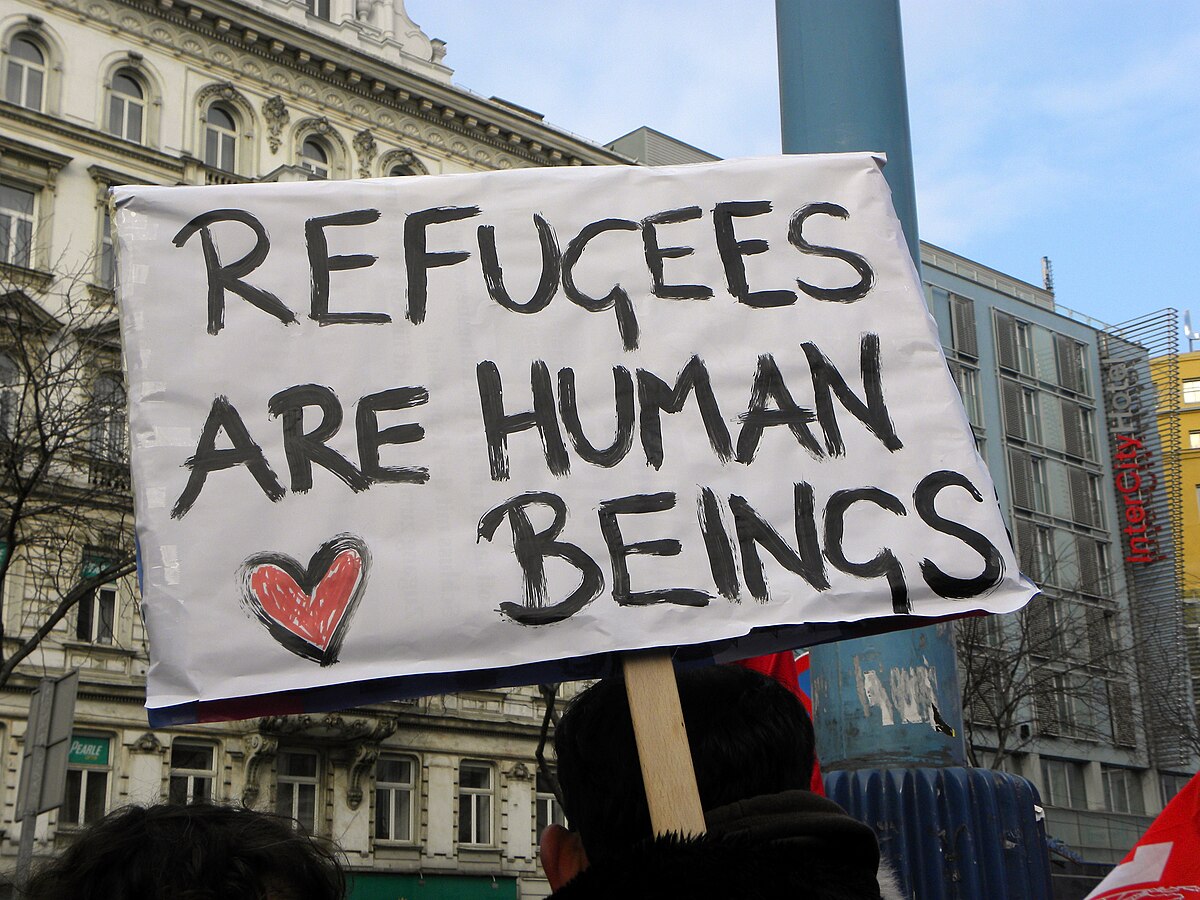
Like so many other issues, the top-down narrative on refugees in Canada is dripping with moralizing. Anyone bringing up questions of practicality routinely gets called racist, xenophobic or evil.
LOOKING DOWN THE NOSE ONCE AGAIN
I have said many times that on major policy issues, public debate – especially the preachifying that emanates from the upper echelons in Canada – remains stuck in the same rut endlessly. As I elaborated on Kushal Mehra’s Caravaka podcast episode recently, this is how the top-down narrative prevails: they keep coming back with the same, long-discredited arguments over and over again and, as Brandolini’s Law states, refuting these takes orders of magnitude greater energy than what they had put in. In the end, the refuters get exhausted, and the narrative-peddlers win. Their ‘win’ is to the detriment of Canada and all Canadians, because the narrative is structurally defective. One encounters this phenomenon on a regular basis; the present article is inspired by one of its recent iterations in a Globe & Mail opinion piece by Konrad Yakabuski with the headline “Canada must admit that Trump’s America is not a ‘safe’ place for refugees”.
The headline stands on the two legs on which many Canadians’ bipedal sense of self-worth stands (and ambulates): moral supremacy and looking down their collective nose at the US. In the Canadian Leftist / Progressive paradigm, its adherents represent the end of moral evolution; no one can be purer – or even come remotely close to being as pure as them. Compared to most other pieces of this nature, however, this one stands apart for its internal inconsistency. For example, take this sentence: “It would be much better that (Immigration Minister) Ms. Diab recognized the STCA’s shortcomings before the courts do so, which could throw Canada’s backlogged refugee system into even more chaos than it is currently experiencing.” Then, the article ends with this: “But maintaining trust in the system is the key to saving it. And that trust will be sorely required when Ottawa finally gets around to scrapping the Safe Third Country Agreement.”
Let’s put 2 and 2 together: Canada’s refugee system is already backlogged and in chaos. If Canada unilaterally scraps the STCA, it would no longer be under the obligation to return refugee claimants who enter Canada from the US. Wouldn’t that put further strain on Canada’s refugee system that the author admits is backlogged and in chaos?
After reading the piece, one is hard put to figure out what the author is advocating for – other than that he wants the processing of refugee claims to be speeded up. But when the backlog is several times our annual capacity to process cases, one wonders if this is more wishful thinking than a practical suggestion.
HARD REALITY
Although inadvertently, Mr. Yakabuski brought us to the crux of the issue with that ending statement, viz., the hard reality that resources are finite, and have alternative uses. The backlog of refugee claims, across the various stages of the process and appeals, is roughly ten times the annual processing capacity. Firstly, it wouldn’t be feasible to scale up that capacity sufficiently to finalize all the cases comprising that backlog in anything resembling a reasonable timeframe. Secondly, and more importantly, we see routinely that an outcome that results in denial of an asylum claim only invites further process, instead of bringing the process to a close and the removal of the individual from Canada. If I may paraphrase a popular saying (‘the process is the punishment’), as far as our refugee system is concerned, the process is the outcome. One recent case illustrates this phenomenon neatly:
- On August 21, 2024, CTV reported that one Charles Mwangi from Kenya was ‘facing deportation in four days’.
- The report doesn’t mention when Mwangi had arrived in Kenya, or whether he crossed over from the US or not – but says that he claimed asylum in 2019.
- Earlier, on July 19, 2024, Migrant Workers’ Alliance for Change had posted a blog entry titled “Stop Charles’ Deportation to Homophobia & Death!”.
- On August 27, 2024, CBC reported that Mwangi’s deportation order had been cancelled. (This report fills us in with the information that he had come to Canada in 2019 on a visitor visa).
- The astute reader will have noticed that Mwangi’s deportation order had been cancelled, not the deportation itself.
- And indeed, the CBC report confirms this: “Mwangi said he has been issued a one-year temporary resident permit and is waiting to hear whether Canada will grant him permanent resident status on humanitarian and compassionate grounds. If that application is denied, he could again face deportation next year.”
- This means that his temporary resident permit would have expired in August 2025, which would have presumably caused a fresh round of media coverage of the case.
- HOWEVER, my Google search for ‘Charles Mwangi Canada’ DOES NOT RETURN ANY RESULT after the deportation order was cancelled. It’s almost as if, once the one-year temporary resident permit was issued, the man simply ceased to exist.
- It is noteworthy that according to the media reports from August 2024, Mwangi had managed to bring his family (wife and three children) to Canada. Their fate is equally unknown.
- To sum up, more than 6 years after Mwangi claimed asylum, we are not sure if his case has been definitively concluded or not.
- Let’s assume that in August 2025, he received permanent resident status, thus bringing the case to a close – and also assume the reason for the absence of reporting on it is that the media had lost interest in his case completely (which is hard to believe; there would be something at least on social media – but let’s assume anyway). This would mean that it took about 6 years to finalize the case. Given the difficulty in furnishing evidence in cases like this, this timeframe may not be atypical.
- So here is a question for Mr. Yakabuski: When you say that “… accelerating the adjudication of refugee claims and discouraging bogus asylum seekers are preconditions to ensuring this country’s ability to uphold the principles of the 1951 United Nations Refugee Convention”, how exactly do you propose to ‘accelerate the adjudication’? With all due respect, the proposed remedy is nothing other than pablum.
MEANS OF SURVIVAL
Another aspect that is taboo to bring up in relation to the refugee system is, how much will this cost the taxpayers? Any intrepid soul who dares to ask this invites a barrage of invective. Nevertheless, we are at a point where irate taxpayers are asking this – but only on social media. Barring exceptions, the mainstream media and the political class have avoided taking up this issue, even when it weighs heavily on the mind of the average Canadian.
The inescapable fact of life is that it takes resources to meet people’s basic needs like shelter, food and clothing. When it comes to refugees, there is a genuine dilemma. If they are allowed to work, they add to the competition for jobs (typically, low-paying jobs), and if not, then they add to the demands on taxpayers’ money. And either way, there is also additional demand on infrastructure (such as housing and schools) as well as services (such as healthcare). Ideally, every plan to invite / admit (insert number) of refugees should be accompanied by a plan for corresponding increases in infrastructure and services. However (and sadly), politics – especially Canadian politics – is not famous for planning in advance. Especially when it comes to refugees – and immigration in general – decisions are announced with an eye on electoral benefit to be gained therefrom. The result is chaos at the ground level – as we learned in June 2023 (see this CBC report), when we learned that asylum seekers were having to sleep on the streets in Toronto, ‘as at-capacity city shelters (were) overwhelmed’. It is worth pausing here to note that in this case, the refugee claimants were adding competition for a service meant for some of the most vulnerable in Canadian society. Letting people into Canada and forcing them into the unwinnable position of this kind is avoidable.
An even more tragic case happened in February 2024, when an asylum seeker froze to her death ‘after waiting hours for a shelter space’ in Mississauga (see this CBC report). The headline of the story also says, “Advocates are demanding action”. It is difficult to judge whether this demand comes from adorable naivety, or performative posturing to gain ‘cred’ in ideological circles, or careerism. It is also difficult to judge which of the three sources is worse than the other two.
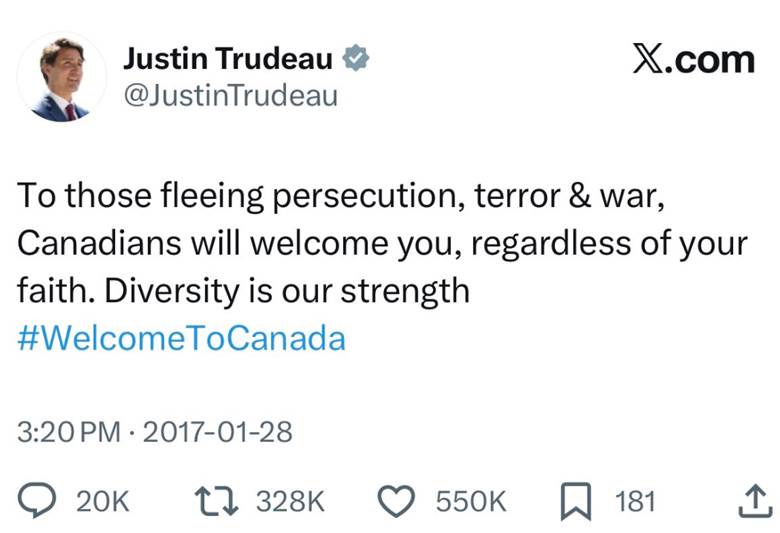
As the saying goes, “If you build it, they will come”. In late-January 2017, then-PM Justin Trudeau made his infamous tweet (my opinion is that his motivation was to poke President Trump’s eye), inviting the entire world to Canada. Well, we built a perception that anyone could just walk into Canada – and they came. Our capacity to provide the necessities of life to refugees having been exhausted, the ‘action’ that is demanded by the ‘advocates’ – if it comes at all – will be at the expense of Canadians who are most desperately in need.
SOCIAL COSTS
The foregoing discussion brings us to the salient point that in addition to financial costs, there are also social costs attached to the refugee program. Unfortunately for us, these costs are paid by us the hoi-polloi and therefore do not figure in the reasoning (if I may use that term charitably here) of the decision-makers and the aforesaid ‘advocates’.
Allocating spending between different uses of money is supposed to be a zero-sum game; increasing spending in one area must come at the expense of spending in other areas. Governments circumvent this uncomfortable reality by incurring debt to avoid cutting down on spending in those other areas. Sometimes, they also resort to diverting existing physical capital to a use for which it was not meant – such as booking entire hotels to house refugees. Unfortunately, dodging the financial dilemma does not mean that the consequences of such poor choices can be avoided. Indeed, these substandard choices are, at best, a band-aid ‘solution’ that merely kicks the can down the road while increasing the overall cost of government and at worst, a pretend solution that exacerbates the problem in other areas. The politician’s game is to see to it that either (a) the increased cost or chain-reaction problems emerge after they ride off into the sunset or (b) these can be blamed on someone else (or on ‘unforeseen’ circumstances that were perfectly foreseeable to most everyone else).
Some instances of this kind of social cost have been noticed even by foreign press. For example, this piece in The Telegraph (UK) titled “Niagara Falls ‘at breaking point’ after surge in migrants” adds that the “City’s hotels are filled with asylum seekers as fears grow that Trump’s immigration crackdown will send more fleeing across the border”. This influx has had a deleterious impact on the city. Of course, the local politicians’ main concern is to obtain more funding from the federal government to cope with the additional demands on services (see this report in The Niagara Independent from November 2024), but social media posts discuss the social costs more frankly (such as the replies to this post on Reddit). What has always been one of the most prized tourist locations in the world has had its value diminished because the politicians desired to evade the zero-sum trade-off. This is not to dismiss the value of any town or city to its residents – each of them deserves to have its worth preserved and enhanced, not diminished.
FEEDBACK LOOP
Given that refugees typically come from countries that have a long – and continuing – history of political instability, the cohort of refugees from each such country has an accumulative characteristic. To elaborate, once settled in Canada, members of this cohort (now permanent residents or citizens) have family and relatives who get caught up in the next iteration of political instability in their country of origin (civil war, widespread unrest – and sometimes even natural calamity). They – and ‘advocates’ – start demanding that the impacted families / relatives be given refuge in Canada. Politicians seeking votes from the concerned diaspora get attracted to these demands like ants are attracted to spilled honey. For example, regarding the civil war currently going on in Sudan, see this report in The Hill Times.
The effect of successive periods of disruption in these countries is, therefore, akin to a snowball; with each batch of refugees from a country arriving in Canada, their ability to get the government to bring over more refugees from their country increases. This is especially true when (or since) diasporas tend to settle in concentrated numbers is specific parts of specific cities. In the calculus of the number of seats that a party needs to win in order to form government, acceding to their demands becomes a political imperative – but the accession must be portrayed to the rest of Canadians as a ‘humanitarian gesture’. “Canada will always step up to help people in danger anywhere in the world”, says the politician – with a wink to the diaspora in question, which erupts in heartfelt applause. In moments of rare – and accidental – candidness, we get to hear something along the lines of “Have you seen the demographics in my riding?”
A MISMATCH MADE IN (OTTAWA) HEAVEN
I now come to a point that is guaranteed to send Progressives into a fit of rage: cultural compatibility. The prevailing Progressive fiction is that all cultures are equal. The hard fact is that they aren’t. Even within one culture – or what is thought of as being one single culture – individuals comport themselves in vastly differing ways; more importantly, there is a wide range of refinement / sophistication in that culture. One aspect of our immigration policy before 2015 was that it had mechanisms that, willfully or otherwise, selected newcomers who were more likely to blend into Canadian culture (for the large part). As a result, there was little friction between the ‘new Canadians’ and those who had been around for a while.
We are by now familiar with the adverse consequences of the Trudeau government (basically) throwing these mechanisms out the window. This has predictably increased the aforesaid friction, although (thankfully) not to the degree that we hear about in Europe. However, we cannot wait around until it reaches that level in Canada also before we start talking about it, primarily because by that time, it will be too late for corrective action. Let me give two instances of friction that have already happened in Canada.
In 2018, a story erupted about a hotel located in the Scarborough area in Toronto. Apparently, this hotel was being used to house refugee claimants. In a breathtakingly ill-advised decision, the people running the hotel continued to offer bookings to regular guests as well. Out of the 240 rooms available, 146 were occupied by refugees. When the two groups – regular guests and refugees – came in direct contact, all hell broke loose (read all about it in this Global News report). On the website Tripadvisor, a more recent review from August 2023 calls a hotel stay in a Toronto hotel (a different one) “Full Blown Refugee Camp Experience”. I had read many of the reviews for the first case (in 2018); all of them were about unruly behaviour of the refugees, including their children. In one case, a child had snatched a lady guest’s cellphone and had run away with it.
TRAJECTORIES
One undeniable fact is that societies have different trajectories of evolution. I know that this is taboo to say in polite company / conversation in Canada, but it is objectively true. However, this is not to suggest that these trajectories are linear and constantly pointed upwards. Many highly advanced civilizations have been wiped out and the current societies of those areas are now undeniably less advanced than other societies. As I have discussed in my article ‘Shared Weaknesses’, societies from different parts of the world are dominant over phases of five or six centuries each. This dominance encompasses the whole gamut of human existence: development of science, technology and the arts, military conquests and political control, all the way down to chicanery and evil deeds.
We are currently in the phase where western civilization is dominant – and has been for about five centuries (which suggests that we may in the final leg of this phase). Over this period, the west has developed (among other achievements) a system of governance and a code of conduct in public that is to be valued. Non-western societies have been exposed to these aspects via colonization, however, post-independence, these societies have pursued their evolutionary path on their own. As a result, the reflection of western modes of personal conduct in these societies is often limited to some segments of the population (at best) or merely a facsimile of the west (at worst). In the case of refugees, there is usually additional negative impact of the breakdown of civic order before they left their country – perhaps even total mayhem. The sum total of these is that there is maximum possibility of extreme mismatch between what kind of behaviour is expected from individuals in Canada versus what behaviour they exhibit.
SANCTION
Ideally, that gap can be filled, at least to a degree where there is a truce of sorts between the sides – even if it is of the ‘uneasy’ variety. Unfortunately, in Canada’s warped notion of multiculturalism (about which I have opined at length in many places), ignoring or justifying even extreme mismatches between newcomers’ behaviour (not just refugees) and the Canadian norm is considered virtuous. In fact, anyone who objects to – or even so much as whispers about – the deviation from Canadian norms is likely to be chastised as ‘racist’ etc. This hectoring only serves to deepen the divide between long-time Canadians and newcomers.
As a result of the factors that I have discussed here – and of the complex interplay between them – putting this genie back in the bottle will be an arduous, protracted battle (and that is assuming that we are, as a society, capable of even attempting it, let alone pull it off). But battles require energy to be devoted to them. It is a lot easier to name-call each other – as ‘racist’ and ‘race traitor’ respectively.
***
Independent voices are more important than ever in today’s Canada. I am happy to add my voice to the public discussions on current issues & policy, and grateful for all the encouraging response from my listeners & readers. I do not believe in a Paywall model, so will not make access to my content subject to a payment.
To help me bring more content to you, please consider donating a small amount via this PayPal link on my website: https://darshanmaharaja.ca/donate/
Image Credit: Haeferl via Wikimedia Commons; the image is at this link. Used without modification under Creative Commons License.
_-_Refugees_are_human_beings.jpg)