


Ever since immigration became a hot issue, it has become fashionable to say that ‘Trudeau broke Canada’s immigration consensus’. But this ‘consensus’ was based on a false narrative that is easily disproved with data.
[Note: This article is Part-2 of my previous article ‘What immigration consensus?’]
UNHEARD VOICES
Until about 10 years ago, I had also believed that there was an ‘immigration consensus’ in Canada. But once my life in Canada had settled down enough for me to have the mental space to dabble in public debates online, I came across an opposing view. An Indian immigrant who was then working as editor for an English language community newspaper in the GTA wrote often about opinion polls showing a fairly high level of opposition to high immigration. His name is Pradip Rodrigues. I corresponded with him via email, and later we became friends.
What struck me at the time was that the lone voice talking about these polls was himself an immigrant. Some years later, I came across an article in Vancouver Sun by journalist Douglas Todd, saying that Indo-Canadians in the Vancouver region were unhappy with the large influx of international students in India. Given how much value the Progressives (which category most of the MSM is a part of) put on ‘lived experience’, the reporting by Pradip and Mr. Todd should have attracted urgent attention.
But because the mess being created by excessive immigration hadn’t reached crisis levels by then, these voices went unheard. At best, they were preaching to the choir, and at worst, they were accused of racism (or, in the case of Pradip, ‘internalized racism’). Smart people see beforehand the problems that are coming and take steps to avert them. People of average intelligence attend to problems after they have occurred. Fools keep denying that problems have occurred, and it always takes a full-blown crisis to get them to accept that they have a problem on their hands – at which point they segue effortlessly to blaming others for the problems. We see this in many policy areas in Canada, and immigration is one of the most salient examples of this shortcoming in Canadian society.
RAISON D’ETRE
No politician will ever tire of saying that ‘Canada needs immigration to boost our economy’. An ancillary statement is that ‘immigrants pay taxes that support Canada’s social programs’. But as I showed in my article ‘Immigration Does NOT Increase Prosperity’, the inflation-adjusted compounded average growth rate (CAGR) in per capita GDP fell by a precipitous 84% between 1970 and 2021, ending up at an anemic 0.67% in the decade ending in 2021:
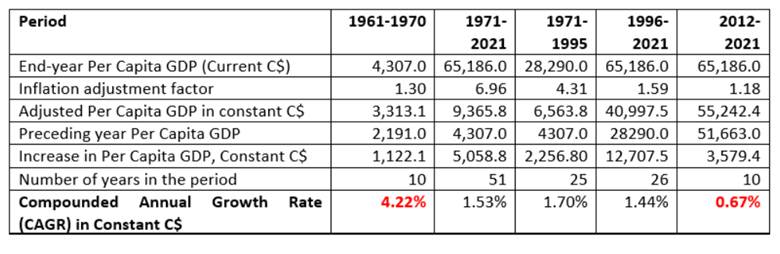
Clearly, the capacity of Canadians – long-time residents and newcomers alike – to ‘boost Canada’s economy’ and ‘pay (more) taxes that support the social programs’ has been eroded almost to zero. It is worth pondering how, in spite of clear signs evidenced by data, the exact opposite narrative could prevail over such a long period, and how so many people subscribed to it. This is as if Abraham Lincoln’s sage statement that “You can fool some people all the time, or all the people for some time, but not all the people all the time” was held in abeyance in Canada from 1970 onwards – or is that the case?
NOTES OF DISCORD
Given the general paucity of resistance to – or criticism of – immigration policy, it is very much possible for the few dissenting voices to start believing that they are the only ones doing so. Thankfully, I am reminded periodically that others have gone down this path before me, thus enabling me to avoid that pitfall. I am constantly reminded of this couplet that the great Urdu poet Mirza Ghalib wrote after hearing a stanza written by Mir Taqi Mir, who had preceded Ghalib by some decades:
Rikhte ke tum hi nahin ustad, Ghalib
Agle zamaane mein Mir bhi tha
(You are not the only master of language, Ghalib
In a previous era, there was Mir too)
[Note: I am not trying to equate myself to the great Ghalib. It would be unpardonably audacious of me to do so.]
When I posted my article ‘Immigration policy needs a DIFFERENT reset’ on X some days ago, reader John Argus (@JohnArgus5) posted this article in the Ottawa Citizen from November 2017, in which author James Bissett had written that “The Trudeau government’s plan to bring in close to one million new immigrants within the next three years should be of serious concern to Canadians.” In the article, he refers to the 1985 MacDonald Royal Commission Report, which concluded that immigration did not contribute to economic growth, and to a two-year study by the Department of Health and Welfare, which supported the MacDonald report and stated there was no argument for increased population growth and that immigration was not the answer to the aging of the population. The author further mentions that “In 1991, the Economic Council of Canada reached the same conclusion.”
In other words, Canadians were being told, more or less in real time, that the narrative (may I call it ‘bill of goods’?) that they were being sold on immigration was false. Yet somehow, these messages, emanating from deep and long studies, failed to penetrate the public consciousness. It begs the question, How?
A DIFFERENT KIND OF GOOSE
Some 3 years ago, I was a guest on the political commentator Spencer Fernando’s podcast. During our chat, he made the observation that Canadian governments had been resorting to ‘goosing up’ the economic numbers, via resorting to inflationary policies and immigration. As a result, the raw numbers kept going higher, when the economy wasn’t doing as well. He was on point here. A detailed exploration of his idea proved to be highly educative to me. In fact, government deficits have outpaced inflation, so the deficit spending is spiraling higher even in inflation-adjusted terms.
For example, in the year 1974-1975, federal deficit was $2.2 billion (see this useful interactive page on CBC’s website and click on the image of Pierre Trudeau in the panel on the left; the drop-down panel will show the deficit figures for each year he was the prime minister). This deficit was 1.4% of the GDP in 1974-1975.
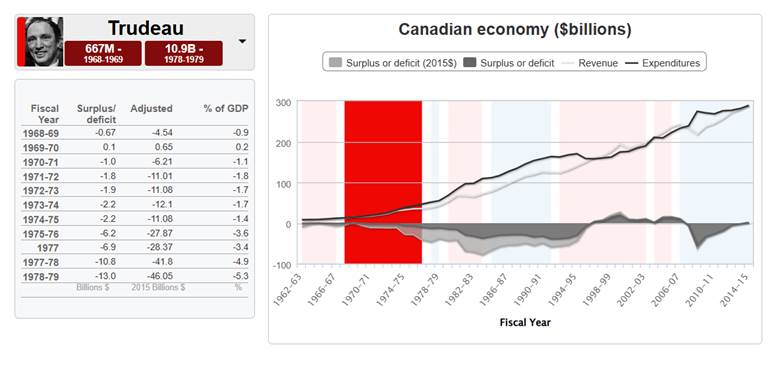
What would the federal deficit be if it had just kept pace with inflation? According to Bank of Canada’s inflation adjustment calculator (see this link), $100 in 1975 is equivalent to $554.70 in 2025, yielding a multiplying factor of 5.547. Accordingly, the federal deficit in 2024-2025 should be $12.20 billion. Instead, according to the government of Canada chart here, it was over $48 billion. In short, growth in federal deficit has outpaced inflation by 300%. In addition, in 2024, the provinces together had a total deficit of $19.8 billion (see this link of Statistics Canada).
Let us remember that in the same period of 1975 to 2025, immigration has constantly trended upwards. The conclusion is inevitable: despite immigrants ‘boosting Canada’s economy’ and ‘paying (more) taxes to fund Canada’s social programs’, governments (plural) found it necessary to print ever-more money out of thin air to keep things going. It is of course true that – as Parkinson’s Law states – expenditure rises to meet income, and tends to surpass it. Also, who doesn’t love to spend other people’s money? Therefore, government spending ballooning to eclipse any additional revenues is hardly unexpected. However, the deficit outpacing inflation by 300% indicates a deeper malaise – but that is a separate inquiry; here, we are focused on the economic numbers that informed the ‘immigration consensus’.
THE WRONG KIND OF ‘FRESH BLOOD’
In my early days in Canada, it had struck me that the ‘settlement funds’ that permanent residents were (and still are) required to bring when landing in Canada represented additional money in the Canadian economy; it wasn’t pre-existing money circulating in the economy, or fresh money coming in as a result of exports. In a nutshell, this was fresh money in the Canadian economy without anyone in Canada having to do any work to earn it; the quid pro quo was a promise of permanent residency and eventually citizenship. As we have learned (the hard way) over the past 3 years, this was a terrible bargain for Canadians. In fact, I view this as a Faustian bargain – we have been trading away Canada, piece by tiny piece, in return for a few coins of silver.
I had wondered at the time as to what the velocity of money was in Canada, and how much this additional money was resulting in higher economic activity. This is a complex topic – to start with, there are several deficnitions of ‘money’, known as M1, M2 etc. Without getting bogged down (and bored), it would suffice to say that the Canadian economy does receive a significant dose of ‘blood transfusion’ on an ongoing basis, as fresh money (that nobody had to work for) keeps flowing in due to immigration.
In the past 3 years, international students have also added significantly to this inflow (at least in theory) – but this is another complex issue because, having brought the stipulated amount of money with them, they remit some of it back to their home country by working in Canada. Calculating the net effect of this churn requires way more knowledge and resources that I possess. Nevertheless, it can be said with confidence that some non-insignificant sum of money was being injected into the Canadian economy by international students until the numbers dropped down significantly this year.
THE GREAT DEBASEMENT
In order to understand what happened to Canada over the past half century, let us take a quick look at an event that took place in England in the middle of the 16th century. It is known as ‘The Great Debasement’. King Henry VIII was overspending on his lavish lifestyle and foreign wars. As a result, the royal treasury started to run out of gold and silver, from which currency was being struck as coins at the time (there was no paper currency). In order to cover the shortfall, the king ordered that the amount of bullion in the coins be reduced. Eventually, they had to resort to striking coins in copper and applying a coating of silver on top. In the course of handling, this layer of silver wore off. Typically, the first part of the coin where it wore off was the the protruding nose of his portrait on the coins, revealing the copper underneath. As a result, Henry VIII acquired the nickname of ‘Old Coppernose’.
MIRAGE
To sum up, as Canada’s economic strength – as reflected in the CAGR for per capita GDP – was declining relentlessly, Canadians kept being told that it was in fact increasing AND THAT IMMIGRATION WAS THE PRIMARY FACTOR FOR THIS ‘GROWTH’. The average Canadian – old-timer and newcomer alike – saw their economic growth being ground down to nothing (literally), but the preaching from the political establishment, academia and MSM was to ‘stay the course’, because ‘immigration grows Canada’s economy’. The difference between the ‘received wisdom’ and personal reality couldn’t be more stark. This reminds me of these lines from a song in the Hindi movie Faraar (released in 1965):
Khush hain sab, aur khushi nahin milti
Zinda hain, zindagi nahin milti
Jal rahe hain charaagh ummeedon ke
Aur kahin roshni nahi milti
(Everyone is happy, but happiness is nowhere to be found,
They are alive, but life is nowhere to be found
The lamps of hope are burning
But light is nowhere to be found)
Granted, before the advent of the internet – and more significantly, of social media – it was relatively easy to suppress studies and reports (like the three mentioned earlier in this article) that informed people that their lived reality was THE reality, not the narrative that was being propagated. But I am flummoxed as to why (or how) the article in Ottawa Citizen did not gain wider attention – albeit from my personal (and admittedly, anecdotal) experience, I can guess. However, my regular readers know that I prefer data and studies to personal anecdotes. Fortunately, I came across an excellent source that helps us understand how the the narrative that was the opposite of people’s reality kept getting sold.
THE POWERS THAT BE
Among the (rapidly growing and increasingly vocal) critics of high immigration, the common refrain is to lay the blame at the feet of the media, especially the ‘bought and paid for’ MSM. But media is merely like the pipeline that delivers the water to you home; the real source is elsewhere. In order to sell, a narrative needs to be given a veneer of credibility, or more preferably, authority. This is the job of people carrying out ‘studies’. Usually, they are located in the academia (and thus largely insulated from the adverse consequences of implementing policies based on their ‘conclusions’).
The source that I came across – a Substack article by Laurenz Guenther, titled ‘Why immigration research is probably biased’ – is bit too technical, but if you are short on time, the following graph from the article will suffice to let you have the gist of it:
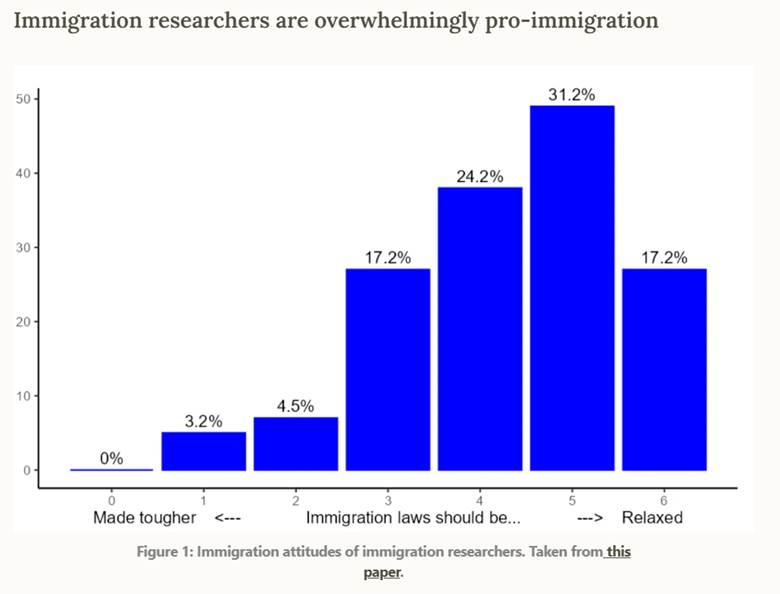
Note that nearly half (48.4%) are in favour of substantial increase in immigration, while another 41.4% would want a bit cautious increase in immigration. In other words. Nearly 9 in 10 immigration reserachers are pro-immigration. As we see often in studies – especially in the social sciences – small choices by the researchers can add up to very different results. But if the researchers’ biases are evenly distributed, then these differences can be minimized. However, when 90% of the researchers lean in one direction, the validity of their findings is called into serious question.
THE PERFECT TRIFECTA
So you have studies on immigration where 90% of the researchers want more immigration, which are brought to a TV near you by a media that is beholden – in some cases, for its very existence – to the political class that wants to sell a particular pro-immigration narrative to mask their failure in delivering genuine economic growth, the net result is an ‘immigration consensus’ that was spun out of whole cloth.
The question is, how should you react when someone talks nostalgically about the ‘immigration consensus’ that Justin Trudeau supposedly broke? I am a big beleiver in personal agency, so I won’t tell you how to respond – but I do have a piece of advice: if you think that disagreeing with the claim is likely to result in personal danger, just smile and nod along. And no matter what else you do, please don’t call Justin Trudeau ‘New Coppernose’.
***
Independent voices are more important than ever in today’s Canada. I am happy to add my voice to the public discussions on current issues & policy, and grateful for all the encouraging response from my listeners & readers. I do not believe in a Paywall model, so will not make access to my content subject to a payment.
To help me bring more content to you, please consider donating a small amount via this PayPal link on my website: https://darshanmaharaja.ca/donate/
Image Credit: Mohamed Hassan via stockvault.net; the image is at this link. Used without modification under Creative Commons License.