


Artificial intelligence (AI) is seen as the latest ‘next big thing’ on which the economic future of nations will hinge. But there are real concerns around its usage of water and energy. Canada must formulate a policy that doesn’t sacrifice public interest.
ENVIRONMENTAL AWARENESS
On June 5, Prime Minister Carney reposted a post by Julie Dabrusin, Canada’s Minister of Environment, Climate Change and Nature, wishing everyone a ‘Happy World Environment Day!’. Her post includes an 18-second video clip, consisting largely of images of various kinds of bodies of water, including a mountain stream gushing over rocks.
Just one day earlier, PM Carney had unveiled his government’s AI strategy and, in a post on X, touted it as ‘AI for all’ (whatever that means). Maybe I have become cynical (or jaded) when it comes to such pronouncements, but I find it difficult to see such phrasing as anything but the typical puff-chested, premature claim by governments that fails to deliver a fraction of what was promised. An earlier, similarly puff-chested announcement in the Trudeau era immediately comes to mind, that of ‘innovation superclusters’. Back in the halcyon days of 2018, before Covid and the immigration mess induced gloom in our minds, and when we were still basking in the warmth of ‘sunny days’ and holding on to the hope that Canada’s economy would ‘grow from the heart out’ as then-PM Trudeau had promised three years prior, Innovation Minister Navdeep Bains has similarly unveiled a strategy to create ‘innovation superclusters’ in Canada. I encourage you to read his statement at the link provided above. I promise you, it will be a hilariously sad experience. As we are painfully aware, not only did no innovation occur, but we also continued to fall behind in basic labour productivity. Therefore, when I hear PM Carney now announcing ‘AI for all’ initiative, my reaction is “I will believe it when I see it”.
However, I consider it my duty as a Canadian to ponder as to what happens if we do see it. For all the excitement – a critic might call it ‘hoopla’ – about AI, there is a thorny aspect to it, viz., data centres. These consume huge amounts of water and energy, and that aspect should be the focus of any critical analysis of the initiative. Sadly, most of the criticism that I have seen so far is about the inclusion of the ‘indigenous’ aspect therein. Having inhabited the political sphere long enough, I am open to considering the possibility that this inclusion was done deliberately, to deflect criticism away from the real issue, viz., the impact of the data centres’ high demand for water and energy on the environment and local communities. Regardless of whether the deference to the indigenous aspect was a deliberate attempt to corral critics in an ineffective area, many critics on social media lacked the strategic sense by obliging readily. But what about the response from opposition politicians?
The leader of the official opposition, and of the Conservative Party of Canada, Pierre Poilievre, in an interview with BNN-Bloomberg, focused exclusively on data security / privacy concerns, the prospect for creating jobs and the need to produce the energy required to power AI. In a 13-minute interview, he did not touch on the environmental aspect, and specifically the concerns around water usage.
WATER, WATER EVERYWHERE
For Canadians, it may be tempting to dismiss the water issue as something that is not a big concern in Canada. Many reports coming out of the US about data centres stressing water supply in the communities where they are located pertain to dry regions, such as Utah; in technical jargon, these areas are classified as ‘water-stressed’ even without the demand from data centres entering the scene. This may have a lulling effect on Canadians; we have lots of water compared to those places.
However, there is some illuminating information in this publication of the University of British Columbia that busts a few myths, one of which is that while Canada has 20% of the world’s fresh water, the renewable supply of fresh water in Canada is only 6.5% of the world’s total. Moreover, considering that most of the Canadian population lives in southern Canada (along the border with the US, in a strip roughly 100 miles wide), the available supply of renewable fresh water drops to 2.6% of the world total; the rest flows north to the subarctic and arctic regions. In other words, the supply of fresh water that we depend on for everything that humans do is roughly 1/8th of what we commonly think of as the ‘amount of fresh water in Canada’.
In addition, we need to factor in the growth in population. While reduced immigration levels have stabilized Canada’s population in the last one year or so, over the long term, growth is bound to resume. Hopefully, it will not be as reckless as we saw between 2022 and 2025, and the infamous target of the Century Initiative to push Canada’s population to 100 million by the year 2100 may not materialize, however, government policy – especially on something as vital as water supply – needs to proceed with utmost caution.
With that background, let us address the key question: Would the data centres needed to support the Canadian government’s AI strategy cause problems with the water supply that communities depend on? As the UBC publication warns: “The myth of water abundance leads Canadians to believe that they have a surplus of freshwater available, and this can result in policy decisions that jeopardise Canada’s water resources and environment in the future.”
PLODDING INQUIRY
As a complete stranger to the issue, I found it difficult to get a clear picture of how much water data centres use. Many of the sources available online are from activist groups that are opposed to data centres. Their bias seeps into the information they present (this is not to dismiss the information they offer, much of which is useful – and besides, most everyone has a bias; what you need is a diversity of sources to arrive at a fair conclusion). On the other hand, mainstream media has a fixation with turning every report into a ‘human interest story’. As a result, one has to plod through a lot of words, an exercise at the end of which one is not necessarily more informed than before. One particular difficulty with both these kinds of sources is the units of measure that they use, for example, “A 100 word email written by using AI uses water equal to a standard water-bottle”, or “The data centre will use water that would be enough to supply the needs of a town with 10,000 population”. I am sure that in a different context, these numbers are useful, but that wasn’t the case for my purpose.
Thankfully, I found two links that helped me assess the water usage by data centres in a meaningful way. One was a report by CBC on a proposed data centre in Toronto, and the other was data on current water usage in Toronto, on the city’s website. Let me walk you through the numbers.
The CBC report says that Microsoft’s data centre in Etobicoke, ON (which was cleared by municipal authorities) was approved to use “39.75 litres of water per second”. Assuming a 24x7x365 usage, that would amount to 1,253,556,000 (or roughly 1.25 billion) litres of water each year. For ease of reporting, the Toronto website uses the measure ML (million litres), so the number for the Microsoft data centre is 1,253.6 ML. How does this compare to the current water usage in the city? According to the Toronto website, the city’s system also supplies water to the southern part of the York Region (which lies immediately to the north of the city). As of May 30, 2026, the YTD number for the water delivered by the system was 181,456 ML. Accordingly, the Microsoft data centre would add 0.69% demand on the city’s water supply system.
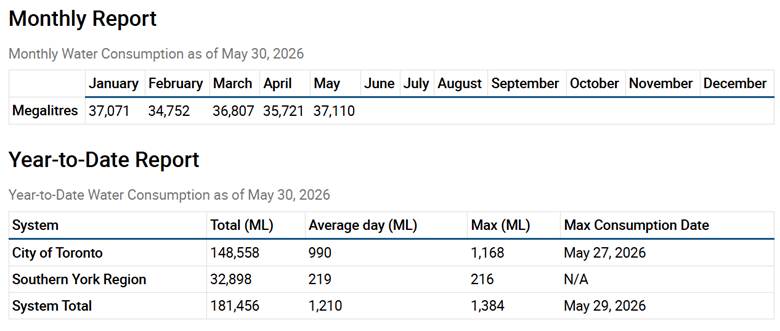
That number (0.69%) may seem insignificant, and the voices being raised about water usage by data centres could be viewed, in the Canadian context, as alarmist or fearmongering. In fact, the company says that “its new Canadian data centres will only use a fraction of that amount”. HOWEVER, the same CBC report mentions that at its data centre in the Netherlands, Microsoft ended up using 4 times the amount of water that it said it would use. Microsoft’s response, that the initial estimate had been based on “consumption at the time” – without specifying what time period it was referring to, is a red flag for our purposes. By the yardstick of what transpired in the Netherlands, the Etobicoke data centre could end up adding 2.76% of Toronto’s water system capability – at which point, we are getting into the territory of ‘this could be relevant’. If, on certain days, there is stress on the water system – yes, that could arise even in Canada, for a variety of reasons – how would the supply be prioritized? The CBC report mentions that in the Netherlands case, “locals were being asked to limit their water use”.
Additionally, Microsoft also has another data centre complex in the works, in Vaughan, which is immediately to the north of Toronto. According to the company, this complex is “expected to consume 730 million litres of water annually”. The city of Vaughan is in the southern York Region, so it is also being supplied by the city of Toronto. If we add the two data centres of Microsoft, in Etobicoke and Vaughan, the ‘initial estimate’ comes to 1,983.6 ML. If we multiply this by 4, the total eventual additional demand for water would be 4.37%. As this point, it would be entirely reasonable to say that there is cause for concern.
ONE TOO MANY?
In order to get a clearer understanding of this issue, we need to zoom out; the discussion is not about one data centre here and another one there. We are looking at the real possibility that there will be ‘heightened interest’ in establishing data centres in Canada. This ‘heightened interest’ can result in a greater number of data centres or in data centres of a bigger size (and probably both). For an example of the latter, there is a proposal for a data centre in the municipal district of Greenview in Alberta (near Grande Prairie) that would take up more than 64 square kilometres. Let us remember that the renewable supply of freshwater in Canada is a bit less than 1/3rd of what we are used to believing, and the situation – especially in smaller towns, where infrastructure may be limited (on account of the small population) – could very easily spiral out of control. According to the municipality’s website, its population is 6,044. No disrespect meant, but that is a tiny community. Its water supply could easily be overwhelmed by a gargantuan data centre – and this would be applicable to a lot of other places.
STEAMING UP?
In all the resources that I was able to find on this issue, I didn’t find a single one that touched upon one aspect of water usage by data centres, viz., its disposal. There are two methods for disposing water after use, but the most prevalent one is evaporation. Especially for the critics who come from an environmental perspective, this is surprising; as we know, water vapour is a Greenhouse Gas (GHG). There doesn’t seem to have been any serious study into how much water vapour would be belched out by these data centres collectively. I don’t claim to be an environmentalist (in fact, I have often been accused of being the opposite), but if I could put on that hat for a moment, I would start with a figure of ‘emissions’ that can be accepted as compromise between progress and conservation, and then work my way backwards to how much capacity of data centres is feasible within that constraint. In fact, that constraint would motivate the industry to achieve lower ‘emissions’ if they want to expand their capacity.
The other method is called ‘closed-loop water cooling’. As the name suggests, this involves a closed loop of pipes or coils in which water keeps circulating. While this cuts down on water usage – and therefore water disposal – drastically (it only requires occasional top-up), the capital outlay is much larger compared to the other method. It is worth exploring whether businesses opt for that other method because it allows them to avoid the financial cost of the systems of pipes, thereby externalizing the cost in the form of water usage to the communities where the data centres are located.
Another emerging method for cooling data centres (see this literature by Florida Water and Pollution Control Operators Association) is ‘immersion cooling’ wherein the data servers are immersed in non-conductive fluid. This method uses minimal amount of water and is therefor more suitable for water-stressed areas – but it also uses much more energy. This means that there is a trade-off between water- and energy usage.
And finally, there is ‘air cooling’, suitable for data centres located in cold climates (such as Canada). In this method, servers are cooled using chilled air; there is a minimal amount of water used for humidification. It is an enigma to me as to why this method hasn’t been talked about in relation to all the proposed large data centres, especially like the one in Greenview, AB. Perhaps the method is not suitable for the kind of data centres that AI requires, but I don’t know enough to say that for sure.
POLICY OVER BROCHURES
One doesn’t have to be a cynic to believe that the ‘initial estimates’ – both by governments and private enterprise – have a way of being overshot, especially in ways that harm (or at least dent) the public interest. In the case of governments, that usually happens on the financial cost front; ‘initial estimates’ are routinely found to have been grossly inadequate. In the case of private enterprise, the affront commonly occurs in respect of the environmental costs of their project. The numbers cited in the early stages turn out to be no more than ‘marketing brochures’ designed to sell the idea to the public with minimal / manageable opposition.
Lest the above be construed as my rejection of data centres, let me state categorically that I do not reject them. My concern is that the policy – and the industry practice – on this exciting development on the techno-economic front should be made in a balanced manner, doing which would require candid acknowledgement of the details and likely consequences (as far as our current knowledge allows us to foresee them). I want Canada not to be left behind in this race – but not at the cost of communities’ well-being, and of the pristine environment that we are blessed with in Canada.
***
Independent voices are more important than ever in today’s Canada. I am happy to add my voice to the public discussions on current issues & policy, and grateful for all the encouraging response from my listeners & readers. I do not believe in a Paywall model, so will not make access to my content subject to a payment.
To help me bring more content to you, please consider donating a small amount via this PayPal link on my website: https://darshanmaharaja.ca/donate/
Image Credit: Wikimedia Commons; the image is at this link. Used without modification under Creative Commons Licence.
